Menopause care built on the whole endocrine system — not just the symptoms.
Endocrinologist-led evaluation and treatment for perimenopause, menopause, and the decades after — HRT done properly, plus the bone, heart, and metabolic care most clinics leave out.
“My periods are changing and I’m not sleeping — is this perimenopause?”
Explore this pathway →The symptoms are real - and treatable.
Perimenopause can begin years before periods stop, and its symptoms are frequently dismissed or misattributed. If several of these sound familiar, a hormonal evaluation is a reasonable next step — whatever your age.
Hot flashes & night sweats
The most recognized symptoms — and among the most disruptive to sleep, work, and daily life.
Sleep & fatigue
Fragmented sleep, early waking, and daytime exhaustion, often compounded by night sweats.
Mood & brain fog
Anxiety, low mood, irritability, and difficulty with focus or word-finding during the transition.
Cycle changes
Irregular, heavier, or skipped periods — often the earliest sign of perimenopause.
Genitourinary symptoms
Vaginal dryness, discomfort with intimacy, and urinary changes that progress without treatment.
Joint & muscle aches
New aches and stiffness — a common and under-recognized feature of falling estrogen.
Weight & body composition
A shift toward abdominal weight and loss of muscle, even without a change in habits.
Silent changes
Bone loss and shifting cholesterol happen without symptoms — which is why they deserve attention now.
Hormones are our specialty.
Endocrinologists train specifically in the body's hormone systems — estrogen and progesterone, but also thyroid, insulin, cortisol, and the hormones that govern bone and metabolism. In midlife, these systems change together.
| Symptom-focused menopause care | Endocrine-led menopause care | |
|---|---|---|
| Primary goal | Relieve hot flashes and immediate symptoms | Relieve symptoms and manage long-term bone, heart, and metabolic health |
| Evaluation | Symptom history | Symptom history plus thyroid, metabolic, lipid, and bone risk assessment |
| Thyroid & diabetes | Referred elsewhere | Managed by the same physician, in the same plan |
| Bone health | Often addressed after a fracture | Screened and treated before one |
| Time horizon | The next refill | The next thirty years |
Listen. Understand. Treat.
Your symptoms, your history, your goals — heard in full, in an unhurried consultation. The evaluation starts with taking them seriously.
Before anything is prescribed, we build your individual risk profile — hormonal, thyroid, metabolic, bone, and cardiovascular. The whole picture, not a template.
An individualized plan at the lowest effective dose — hormonal, non-hormonal, or both — monitored and fine-tuned over time, by a physician who follows through.
HRT, done properly: individualized, evidence-based, monitored.
Hormone therapy is the most effective treatment for hot flashes, night sweats, and genitourinary symptoms, and it protects bone. For most healthy women within ten years of menopause, current guidelines support its use — the question is not simply whether HRT, but which hormones, at what dose, by what route, for you.
The right formulation
Transdermal or oral estrogen, micronized progesterone, vaginal estrogen, testosterone where appropriate — the differences matter, and we explain them plainly.
The right candidate assessment
Clotting, breast health, cardiovascular risk, migraine — assessed systematically before prescribing, not after.
The right follow-up
Doses adjusted to response, risks re-reviewed over time, and a plan that evolves as you do.
Physician-scientists. Board-certified endocrinologists. Your doctors.
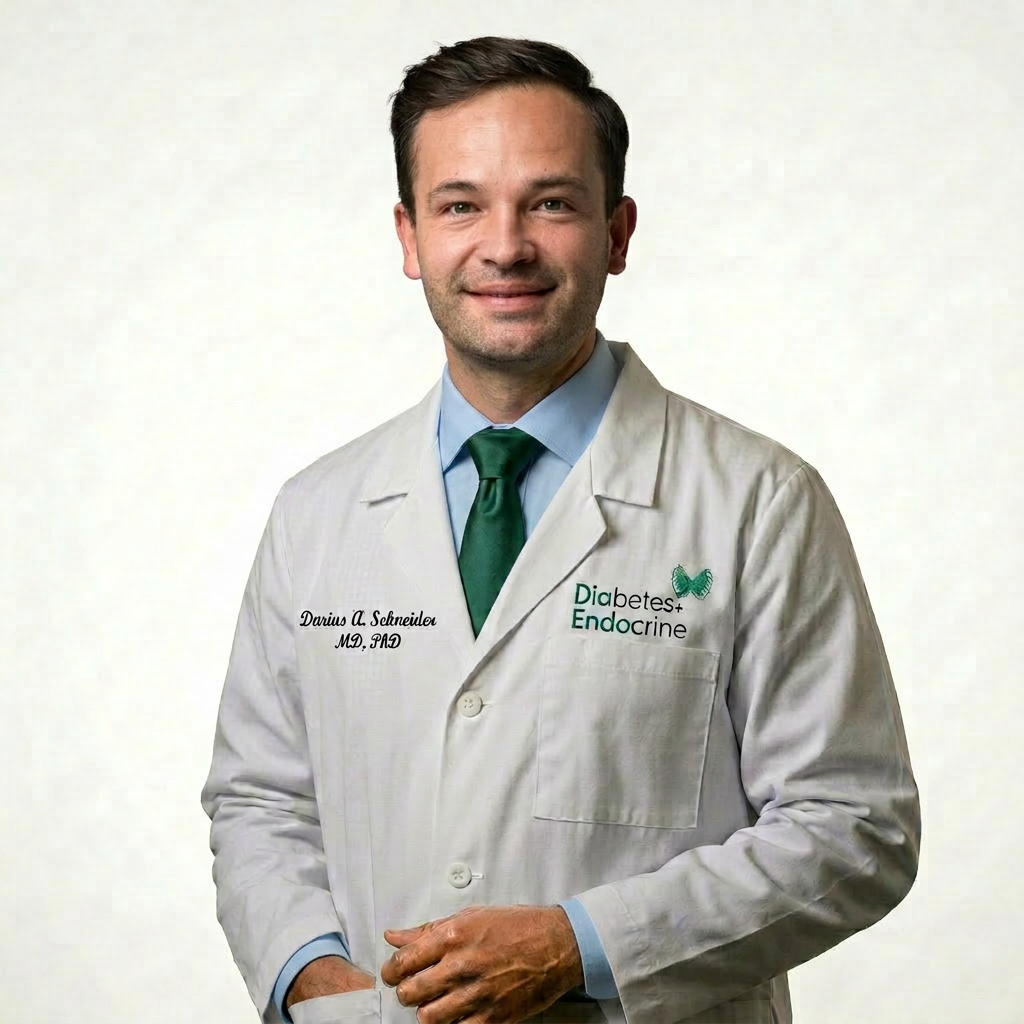
Darius A. Schneider, MD, PhD
President & Medical Director · Board-certified, Internal Medicine & Endocrinology
Trained at Giessen, Uppsala, Heidelberg, UC San Diego, and the University of Washington; published in Diabetes Care and Diabetologia; presented the practice's research at ENDO 2026.

Mba Uzoma Mba, MD, PhD
Board-certified, Endocrinology, Diabetes & Metabolism
MD/PhD from Virginia Commonwealth University and the Scripps Research Institute; fellowship at Scripps Clinic; particular interest in hormonal conditions in women, thyroid disease, and bone health.
Direct answers, before you even call.
Do I need an endocrinologist for menopause, or is my OB/GYN enough?
Many women do well with their OB/GYN. An endocrinologist adds the most value when the picture is complicated: thyroid disease, diabetes, weight change, osteoporosis risk, premature or surgical menopause, or treatment that hasn't worked. Full answer →
Is HRT safe?
For most healthy women who start within about ten years of menopause, current evidence supports hormone therapy as safe and effective. Individual factors change that balance — we'll give you numbers for your situation, not slogans. The honest numbers →
Do you prescribe "bioidentical" hormones?
We routinely prescribe FDA-approved, body-identical estradiol and micronized progesterone. We do not recommend custom-compounded pellets or creams. Why →
My labs are "normal" — can this still be perimenopause?
Yes. Hormones fluctuate widely in the transition; diagnosis rests on age, cycle pattern, and symptoms. The full explanation →
Do you take insurance?
Most major plans, including Medicare — this is a medical practice, not a cash-pay subscription. Insurance & fees →
Three offices across San Diego County.
Referring a patient? We keep referring physicians informed throughout treatment and follow-up. Referral details →